Four hundred metres of elevation change in a single round at Carezza, between four and a half and five hours at Asiago: seven days of golf are a small physical feat, and it pays to prepare a few weeks ahead.
Anyone who plays now and then and then leaves for a week of golf goes from zero to six or seven rounds in a few days, with the same joints as ever. This article is neither a training plan nor medical advice: it gathers general guidance from authoritative sources and club data to help you decide how to prepare. For any doubt about your health, the right person is your doctor.
What the medical source says: golf is not "low risk"
The American Academy of Orthopaedic Surgeons (AAOS) points out that many people regard golf as an undemanding activity, but that it can cause injuries to the ankle, elbow, back, knee, hip, hand and wrist. It cites a review in the British Journal of Sports Medicine (March 2024) according to which more than half of golfers risk a musculoskeletal injury in their lifetime: 56.6% among amateurs. According to some studies, amateurs who play more than three or four rounds a week have a higher risk than those who play less: a week's holiday with a round a day exceeds that frequency. Most injuries, the AAOS explains, stem from overuse: repeating the same movement always stresses the same muscles, tendons and joints.
The weeks before: starting gradually
The AAOS, in its guide to starting an exercise programme, recommends beginning slowly and steadily, especially if you have not trained for some time, and consulting your doctor before intense activity if you have health problems such as high blood pressure or diabetes. A balanced programme, it writes, has three elements: aerobic conditioning, flexibility and strength; for aerobic work a general guideline is to build up to 20-30 minutes a day, three or four days a week, with walking, running or cycling. The World Health Organization sets as a general threshold for adults at least 150 minutes a week of moderate activity. For a week of golf, walking is the most fitting exercise: a round involves a lot of it.
For the back, the most frequent complaint among golfers, the AAOS suggests exercises with a resistance band (rowing and pull down, three sets of ten, at least three times a week), plus yoga and pilates for core strength. For the elbow, exercises for the forearm muscles such as the tennis ball squeeze and wrist curl. These are examples from the source, not a prescription.
Round day: warming up before you hit
Warming up is the advice the AAOS repeats most: always before the round. The idea is to bring blood to the muscles and raise their temperature: some simple stretching for shoulders, back and legs, then a few balls on the practice range, starting with the wedges and working up through the bag to the driver. The practice range is paid for separately at most clubs: at Is Molas the 2026 price list shows 15 euros, 25 with equipment. After the round, says the AAOS, stretching while the muscles are still warm reduces the risk of injury.
The course matters: elevation change and duration
Not all courses demand the same effort. A few examples from the clubs in the catalogue:
| Club | What the club says |
|---|---|
| Golf Club Carezza | Nine holes at 1,680 metres; up to 400 metres of elevation change in one round; you need "stamina and endurance" |
| Golf Club Colline del Gavi | Elevation changes that call for "good legs" |
| Circolo Golf Asiago | Gently profiled plateau, modest elevation changes; a round that can be walked in 4 and a half to 5 hours |
| Golf Club Casalunga | Layout described by the club as "walkable" |
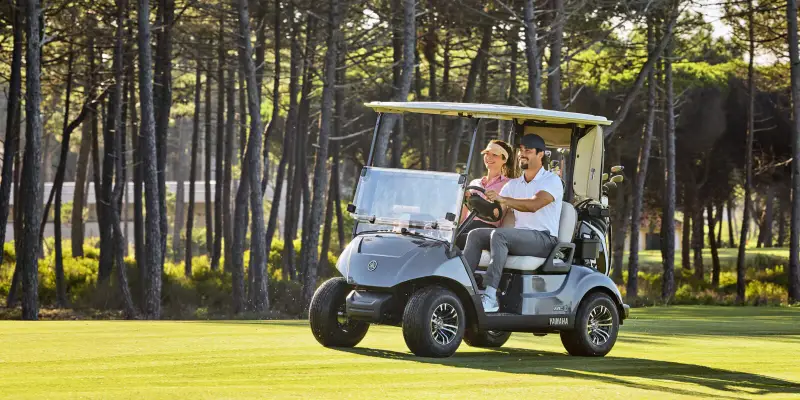
Over a full week it pays to alternate: one demanding course and one flat one, or a nine-hole round between two of eighteen. For those who prefer not to carry the bag, trolleys and golf carts are available: at Is Molas, in the 2026 price list, a golf cart costs 50-60 euros for 18 holes and an electric trolley 20-25 euros a day. In club competitions, the Italian Golf Federation reminds us, the cart is allowed for seniors or for anyone presenting a medical certificate.
Shoes, sun, water and thunderstorms
According to the AAOS, shoes should be comfortable, give good support and not cause blisters. These general tips are also worth remembering:
- Hydration. Drink before, during and after the round, even when you are not thirsty; alcohol contributes to dehydration.
- Sun. Sunscreen, sunglasses that filter UVA and UVB rays, and a cap with a visor.
- Thunderstorms. At the first signs, take shelter in a sturdy building or a closed vehicle; avoid open spaces, small shelters and trees.
- Golf cart. Keep your feet inside: some players have broken an ankle with a foot under the moving vehicle.
- Look out for others. A ball can strike: watch out for those playing.
Frequently asked questions
How long before should I start preparing?+
The sources give no number of weeks: the AAOS recommends starting gradually and building up, as a general guideline, to 20-30 minutes of aerobic activity a day for three or four days a week. If you have health problems, ask your doctor.
Is warming up before playing really necessary?+
The AAOS always recommends it: stretching for shoulders, back and legs, then balls on the practice range, from the wedges up to the driver.
What is the most common injury?+
For the AAOS, back problems are the most common complaint among golfers, followed by golfer's elbow (medial epicondylitis).
Is it better to walk or use a golf cart?+
It depends on the course and your fitness. Walking is good exercise, but on a mountain course such as Carezza, with up to 400 metres of elevation change, the club warns that you need stamina and endurance.
Can I play a round a day for seven days?+
For the AAOS, amateurs who play more than three or four rounds a week may face a higher risk: consider nine holes on some days and alternate demanding and easy courses.